UI / UX Design
ila26 — Energy — CRM Mobile App
End-to-end design of a mobile CRM built from scratch for energy professionals in France — covering the full sales pipeline from lead to invoice, with a multi-company architecture and opportunity types that dynamically adapt the entire interface based on the project context.
Year :
2025
Industry :
Energy
Client :
ila26
Project Duration :
2+ years

Overview :
The ila26 Energy CRM is a mobile-first tool built for energy installation companies operating across France — primarily in solar photovoltaic, energy renovation, and smart thermostat projects, …etc. Field teams and commercial agents manage their full pipeline from a single app: from the first contact to site visits, technical studies, proposals, and final invoicing.
The app supports multiple companies simultaneously. Users can switch between companies directly from the top bar, and every section — opportunities, contacts, calendar, invoices — updates instantly to reflect the selected company's data. This multi-tenant architecture was a core design constraint from day one.

The challenge :
This was not a generic CRM. Energy projects in France involve highly specific workflows — photovoltaic studies, roof technical assessments, cadastre data, construction progress stages — that standard CRM tools don't account for. The challenge was designing a system flexible enough to handle multiple opportunity types (Photovoltaïque BtoB, Rénovation d'ampleur, Thermostat), where each type could have different tabs, different fields, and completely different content inside the same opportunity — without the interface feeling inconsistent or confusing.
The second challenge was mobile density. CRM systems are traditionally built for desktop. Fitting complex, multi-tab opportunity detail screens — with propositions, technical project data, photovoltaic studies, photos, documents, activity history, and tasks — onto a phone screen without losing usability required rethinking how information was structured and revealed.

What I Designed :
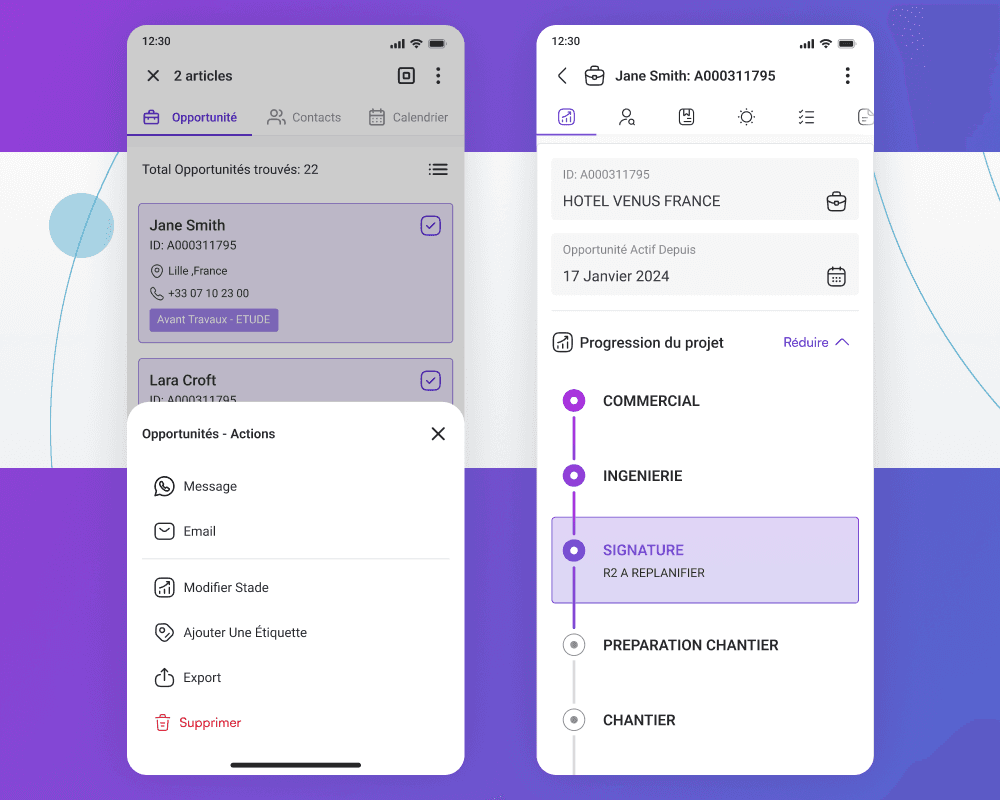
Opportunities: The core of the CRM. A list of all active opportunities per company, filterable by status and fully customizable in terms of which columns or fields appear in the view. Each opportunity opens into a multi-tab detail screen — navigated by icon tabs on mobile — covering: general information and pipeline stage, contact information, photovoltaic study (cadastre data, roof type, orientation, technical specs), project information (configuration module, inverter specs, PDF generation), photos (categorized by site type), documents, activity history and comments, tasks, and commercial propositions with line items, quantities, taxes, and totals. The pipeline itself tracks stages from Commercial through Engineering, Signature, Site Preparation, Construction, and Payment — with the current stage always visible and editable directly from the opportunity.
Contacts: A searchable directory of all contacts linked to the active company. Each contact card opens a quick-inspect panel showing full contact details, linked company, number of opportunities, appointments, and total invoice value — with direct actions to edit, delete, or view linked opportunities. New contacts can be created directly when adding a new opportunity, with existing contact linking also supported.
Calendar: Two views: a daily programme view (organized by installer, showing all appointments and tasks for that day with opportunity references) and a standard monthly calendar view with color-coded events per opportunity. Managers can see their full team's schedule organized by installer. A key feature: comments and progress updates can be added to an opportunity directly from the calendar without navigating away, keeping field teams moving without breaking their flow.
Facturation (invoicing): A full invoicing module covering both devis (quotes) and factures (invoices), linked to opportunities or created independently. Each document shows type, status (Créé, Accepté, Annulé), HT and TTC amounts, and reference numbers. Actions include inspecting, duplicating, viewing as PDF, downloading, changing status, and creating credit notes. Cancelled invoices remain permanently in the system for audit purposes.
Reflection :
This was the most technically complex product I designed at ila26. Building it from scratch — with no existing mobile design system to reference — meant making foundational decisions early that would have to scale across 250+ screens. The dynamic opportunity type system was the hardest design problem: the same screen had to feel coherent whether it was showing a photovoltaic BtoB project or a thermostat installation, despite having different tabs and different data. Getting that consistency right without rigidly constraining the content took multiple iterations. Presenting the final designs directly to stakeholders and walking them through the decisions made me a much more confident designer.


More Projects


UI / UX Design
ila26 — Energy — CRM Mobile App
End-to-end design of a mobile CRM built from scratch for energy professionals in France — covering the full sales pipeline from lead to invoice, with a multi-company architecture and opportunity types that dynamically adapt the entire interface based on the project context.
Year :
2025
Industry :
Energy
Client :
ila26
Project Duration :
2+ years
Overview :
The ila26 Energy CRM is a mobile-first tool built for energy installation companies operating across France — primarily in solar photovoltaic, energy renovation, and smart thermostat projects, …etc. Field teams and commercial agents manage their full pipeline from a single app: from the first contact to site visits, technical studies, proposals, and final invoicing.
The app supports multiple companies simultaneously. Users can switch between companies directly from the top bar, and every section — opportunities, contacts, calendar, invoices — updates instantly to reflect the selected company's data. This multi-tenant architecture was a core design constraint from day one.
The challenge :
This was not a generic CRM. Energy projects in France involve highly specific workflows — photovoltaic studies, roof technical assessments, cadastre data, construction progress stages — that standard CRM tools don't account for. The challenge was designing a system flexible enough to handle multiple opportunity types (Photovoltaïque BtoB, Rénovation d'ampleur, Thermostat), where each type could have different tabs, different fields, and completely different content inside the same opportunity — without the interface feeling inconsistent or confusing.
The second challenge was mobile density. CRM systems are traditionally built for desktop. Fitting complex, multi-tab opportunity detail screens — with propositions, technical project data, photovoltaic studies, photos, documents, activity history, and tasks — onto a phone screen without losing usability required rethinking how information was structured and revealed.
What I Designed :
Opportunities: The core of the CRM. A list of all active opportunities per company, filterable by status and fully customizable in terms of which columns or fields appear in the view. Each opportunity opens into a multi-tab detail screen — navigated by icon tabs on mobile — covering: general information and pipeline stage, contact information, photovoltaic study (cadastre data, roof type, orientation, technical specs), project information (configuration module, inverter specs, PDF generation), photos (categorized by site type), documents, activity history and comments, tasks, and commercial propositions with line items, quantities, taxes, and totals. The pipeline itself tracks stages from Commercial through Engineering, Signature, Site Preparation, Construction, and Payment — with the current stage always visible and editable directly from the opportunity.
Contacts: A searchable directory of all contacts linked to the active company. Each contact card opens a quick-inspect panel showing full contact details, linked company, number of opportunities, appointments, and total invoice value — with direct actions to edit, delete, or view linked opportunities. New contacts can be created directly when adding a new opportunity, with existing contact linking also supported.
Calendar: Two views: a daily programme view (organized by installer, showing all appointments and tasks for that day with opportunity references) and a standard monthly calendar view with color-coded events per opportunity. Managers can see their full team's schedule organized by installer. A key feature: comments and progress updates can be added to an opportunity directly from the calendar without navigating away, keeping field teams moving without breaking their flow.
Facturation (invoicing): A full invoicing module covering both devis (quotes) and factures (invoices), linked to opportunities or created independently. Each document shows type, status (Créé, Accepté, Annulé), HT and TTC amounts, and reference numbers. Actions include inspecting, duplicating, viewing as PDF, downloading, changing status, and creating credit notes. Cancelled invoices remain permanently in the system for audit purposes.
Reflection :
This was the most technically complex product I designed at ila26. Building it from scratch — with no existing mobile design system to reference — meant making foundational decisions early that would have to scale across 250+ screens. The dynamic opportunity type system was the hardest design problem: the same screen had to feel coherent whether it was showing a photovoltaic BtoB project or a thermostat installation, despite having different tabs and different data. Getting that consistency right without rigidly constraining the content took multiple iterations. Presenting the final designs directly to stakeholders and walking them through the decisions made me a much more confident designer.
More Projects
UI / UX Design
ila26 — Energy — CRM Mobile App
End-to-end design of a mobile CRM built from scratch for energy professionals in France — covering the full sales pipeline from lead to invoice, with a multi-company architecture and opportunity types that dynamically adapt the entire interface based on the project context.
Year :
2025
Industry :
Energy
Client :
ila26
Project Duration :
2+ years
Overview :
The ila26 Energy CRM is a mobile-first tool built for energy installation companies operating across France — primarily in solar photovoltaic, energy renovation, and smart thermostat projects, …etc. Field teams and commercial agents manage their full pipeline from a single app: from the first contact to site visits, technical studies, proposals, and final invoicing.
The app supports multiple companies simultaneously. Users can switch between companies directly from the top bar, and every section — opportunities, contacts, calendar, invoices — updates instantly to reflect the selected company's data. This multi-tenant architecture was a core design constraint from day one.
The challenge :
This was not a generic CRM. Energy projects in France involve highly specific workflows — photovoltaic studies, roof technical assessments, cadastre data, construction progress stages — that standard CRM tools don't account for. The challenge was designing a system flexible enough to handle multiple opportunity types (Photovoltaïque BtoB, Rénovation d'ampleur, Thermostat), where each type could have different tabs, different fields, and completely different content inside the same opportunity — without the interface feeling inconsistent or confusing.
The second challenge was mobile density. CRM systems are traditionally built for desktop. Fitting complex, multi-tab opportunity detail screens — with propositions, technical project data, photovoltaic studies, photos, documents, activity history, and tasks — onto a phone screen without losing usability required rethinking how information was structured and revealed.
What I Designed :
Opportunities: The core of the CRM. A list of all active opportunities per company, filterable by status and fully customizable in terms of which columns or fields appear in the view. Each opportunity opens into a multi-tab detail screen — navigated by icon tabs on mobile — covering: general information and pipeline stage, contact information, photovoltaic study (cadastre data, roof type, orientation, technical specs), project information (configuration module, inverter specs, PDF generation), photos (categorized by site type), documents, activity history and comments, tasks, and commercial propositions with line items, quantities, taxes, and totals. The pipeline itself tracks stages from Commercial through Engineering, Signature, Site Preparation, Construction, and Payment — with the current stage always visible and editable directly from the opportunity.
Contacts: A searchable directory of all contacts linked to the active company. Each contact card opens a quick-inspect panel showing full contact details, linked company, number of opportunities, appointments, and total invoice value — with direct actions to edit, delete, or view linked opportunities. New contacts can be created directly when adding a new opportunity, with existing contact linking also supported.
Calendar: Two views: a daily programme view (organized by installer, showing all appointments and tasks for that day with opportunity references) and a standard monthly calendar view with color-coded events per opportunity. Managers can see their full team's schedule organized by installer. A key feature: comments and progress updates can be added to an opportunity directly from the calendar without navigating away, keeping field teams moving without breaking their flow.
Facturation (invoicing): A full invoicing module covering both devis (quotes) and factures (invoices), linked to opportunities or created independently. Each document shows type, status (Créé, Accepté, Annulé), HT and TTC amounts, and reference numbers. Actions include inspecting, duplicating, viewing as PDF, downloading, changing status, and creating credit notes. Cancelled invoices remain permanently in the system for audit purposes.
Reflection :
This was the most technically complex product I designed at ila26. Building it from scratch — with no existing mobile design system to reference — meant making foundational decisions early that would have to scale across 250+ screens. The dynamic opportunity type system was the hardest design problem: the same screen had to feel coherent whether it was showing a photovoltaic BtoB project or a thermostat installation, despite having different tabs and different data. Getting that consistency right without rigidly constraining the content took multiple iterations. Presenting the final designs directly to stakeholders and walking them through the decisions made me a much more confident designer.