UI / UX Design
Wareed — Appointment booking and patients management Copy
End-to-end UI/UX design for a dual-sided healthcare mobile app connecting patients with doctors across Algeria — with a focus on trust, accessibility, and a severely underserved digital health market.
Year :
2023
Industry :
HealthCare
Client :
Wareed
Project Duration :
3 months

Problem :
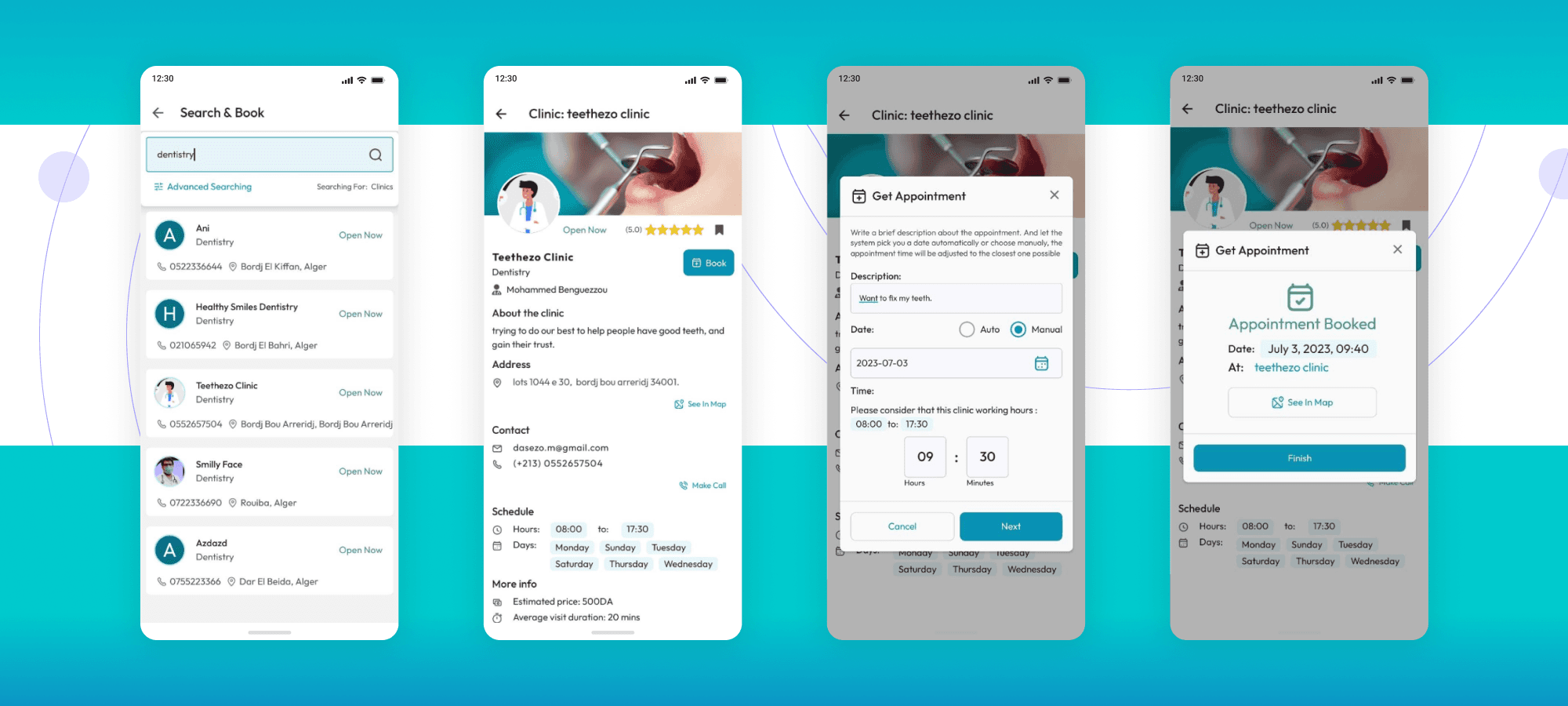
Finding a clinic in Algeria is largely an offline problem. There is no central, reliable source of information — no directory patients can trust, no way to verify a clinic's contact number is still active, and no way to know if a specific practice treats the condition you're dealing with. People ask family, ask neighbours, or call numbers that no longer work. Clinic information is scattered, outdated, and inaccessible — and the result is that patients make uninformed decisions about something that directly affects their health.
Solution :
Wareed was designed as two completely separate apps within one — a patient-facing booking and health management interface, and a doctor-facing schedule, patient management, and appointment control panel. Both sides had to feel native to their respective users: a patient browsing on a midrange Android, and a doctor reviewing their day between consultations.
Patients can discover specialists by specialty, city, and availability — filter by rating, consultation type, and gender — and book directly with real-time slot confirmation. Their profile tracks medical history, upcoming and past appointments, and saved doctors. Arabic-first design was applied throughout, ensuring the experience felt natural and not like a translation from a Western health app.
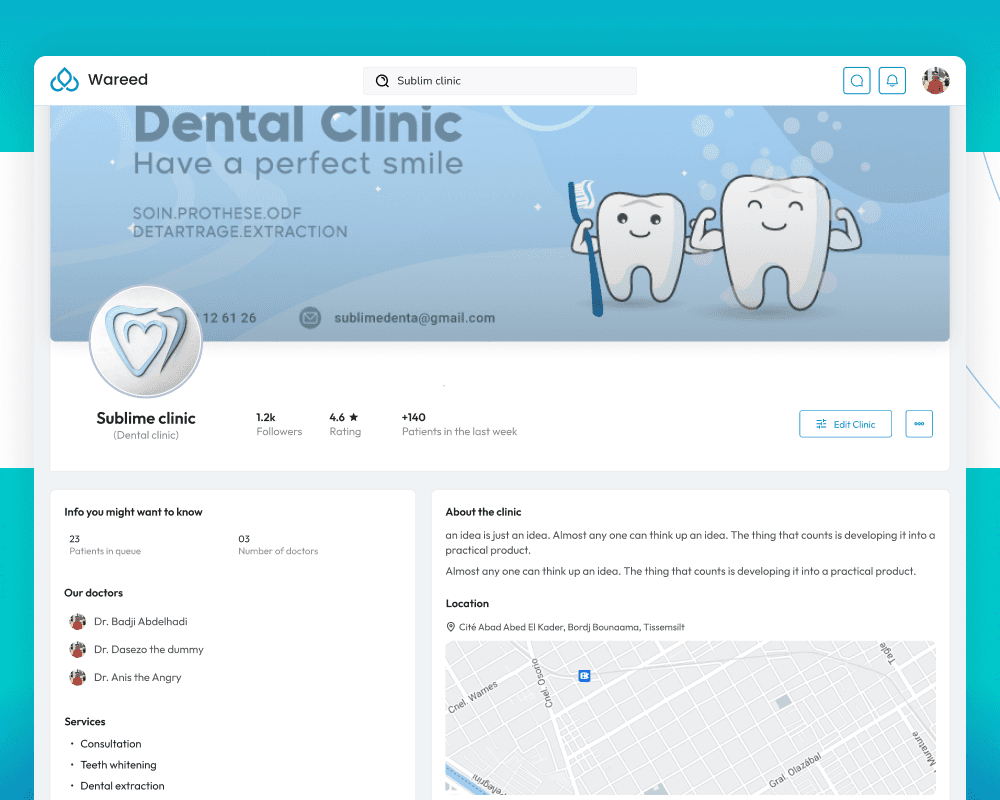
Doctors and clinic administrators get a dedicated dashboard: appointment scheduling, patient profiles, confirmation flows, and a calendar view that replaces the paper logbook. Verified doctor badges build patient trust. A review system with moderation creates a quality signal for both sides.

Challenge :
The core design challenge for Wareed was the same fundamental problem that faces every healthcare marketplace: why would a patient trust a doctor they've never seen — and why would a doctor trust that a new patient's profile data is accurate?
Unlike Tamkeen, where the stakes of trust failure are a missed job application, in healthcare the consequences of bad information are significantly higher. The design had to build real confidence on both sides — not just aesthetic polish.
The second challenge was scope under constraint. As a graduation project with no development budget, every design decision had to account for real-world implementation: flows had to be clean enough to actually be built by a small team, without cutting features that were genuinely necessary for the product to work.
Summary :
Wareed was built around a real and specific gap: the absence of reliable, centralised healthcare information in Algeria. The design decisions — from public search without login, to mandatory clinic profiles, to the automated patient invitation system — were all direct responses to the behaviours the Algerian market actually has, not theoretical ones. For an MVP, the goal was to deliver enough value on both sides of the platform to make adoption worth it.


More Projects


UI / UX Design
Wareed — Appointment booking and patients management Copy
End-to-end UI/UX design for a dual-sided healthcare mobile app connecting patients with doctors across Algeria — with a focus on trust, accessibility, and a severely underserved digital health market.
Year :
2023
Industry :
HealthCare
Client :
Wareed
Project Duration :
3 months
Problem :
Finding a clinic in Algeria is largely an offline problem. There is no central, reliable source of information — no directory patients can trust, no way to verify a clinic's contact number is still active, and no way to know if a specific practice treats the condition you're dealing with. People ask family, ask neighbours, or call numbers that no longer work. Clinic information is scattered, outdated, and inaccessible — and the result is that patients make uninformed decisions about something that directly affects their health.
Solution :
Wareed was designed as two completely separate apps within one — a patient-facing booking and health management interface, and a doctor-facing schedule, patient management, and appointment control panel. Both sides had to feel native to their respective users: a patient browsing on a midrange Android, and a doctor reviewing their day between consultations.
Patients can discover specialists by specialty, city, and availability — filter by rating, consultation type, and gender — and book directly with real-time slot confirmation. Their profile tracks medical history, upcoming and past appointments, and saved doctors. Arabic-first design was applied throughout, ensuring the experience felt natural and not like a translation from a Western health app.
Doctors and clinic administrators get a dedicated dashboard: appointment scheduling, patient profiles, confirmation flows, and a calendar view that replaces the paper logbook. Verified doctor badges build patient trust. A review system with moderation creates a quality signal for both sides.
Challenge :
The core design challenge for Wareed was the same fundamental problem that faces every healthcare marketplace: why would a patient trust a doctor they've never seen — and why would a doctor trust that a new patient's profile data is accurate?
Unlike Tamkeen, where the stakes of trust failure are a missed job application, in healthcare the consequences of bad information are significantly higher. The design had to build real confidence on both sides — not just aesthetic polish.
The second challenge was scope under constraint. As a graduation project with no development budget, every design decision had to account for real-world implementation: flows had to be clean enough to actually be built by a small team, without cutting features that were genuinely necessary for the product to work.
Summary :
Wareed was built around a real and specific gap: the absence of reliable, centralised healthcare information in Algeria. The design decisions — from public search without login, to mandatory clinic profiles, to the automated patient invitation system — were all direct responses to the behaviours the Algerian market actually has, not theoretical ones. For an MVP, the goal was to deliver enough value on both sides of the platform to make adoption worth it.
More Projects
UI / UX Design
Wareed — Appointment booking and patients management Copy
End-to-end UI/UX design for a dual-sided healthcare mobile app connecting patients with doctors across Algeria — with a focus on trust, accessibility, and a severely underserved digital health market.
Year :
2023
Industry :
HealthCare
Client :
Wareed
Project Duration :
3 months
Problem :
Finding a clinic in Algeria is largely an offline problem. There is no central, reliable source of information — no directory patients can trust, no way to verify a clinic's contact number is still active, and no way to know if a specific practice treats the condition you're dealing with. People ask family, ask neighbours, or call numbers that no longer work. Clinic information is scattered, outdated, and inaccessible — and the result is that patients make uninformed decisions about something that directly affects their health.
Solution :
Wareed was designed as two completely separate apps within one — a patient-facing booking and health management interface, and a doctor-facing schedule, patient management, and appointment control panel. Both sides had to feel native to their respective users: a patient browsing on a midrange Android, and a doctor reviewing their day between consultations.
Patients can discover specialists by specialty, city, and availability — filter by rating, consultation type, and gender — and book directly with real-time slot confirmation. Their profile tracks medical history, upcoming and past appointments, and saved doctors. Arabic-first design was applied throughout, ensuring the experience felt natural and not like a translation from a Western health app.
Doctors and clinic administrators get a dedicated dashboard: appointment scheduling, patient profiles, confirmation flows, and a calendar view that replaces the paper logbook. Verified doctor badges build patient trust. A review system with moderation creates a quality signal for both sides.
Challenge :
The core design challenge for Wareed was the same fundamental problem that faces every healthcare marketplace: why would a patient trust a doctor they've never seen — and why would a doctor trust that a new patient's profile data is accurate?
Unlike Tamkeen, where the stakes of trust failure are a missed job application, in healthcare the consequences of bad information are significantly higher. The design had to build real confidence on both sides — not just aesthetic polish.
The second challenge was scope under constraint. As a graduation project with no development budget, every design decision had to account for real-world implementation: flows had to be clean enough to actually be built by a small team, without cutting features that were genuinely necessary for the product to work.
Summary :
Wareed was built around a real and specific gap: the absence of reliable, centralised healthcare information in Algeria. The design decisions — from public search without login, to mandatory clinic profiles, to the automated patient invitation system — were all direct responses to the behaviours the Algerian market actually has, not theoretical ones. For an MVP, the goal was to deliver enough value on both sides of the platform to make adoption worth it.